How to Apply for Permanent Residency in Canada in 2026: Step-by-Step Guide
Canucks Immigration
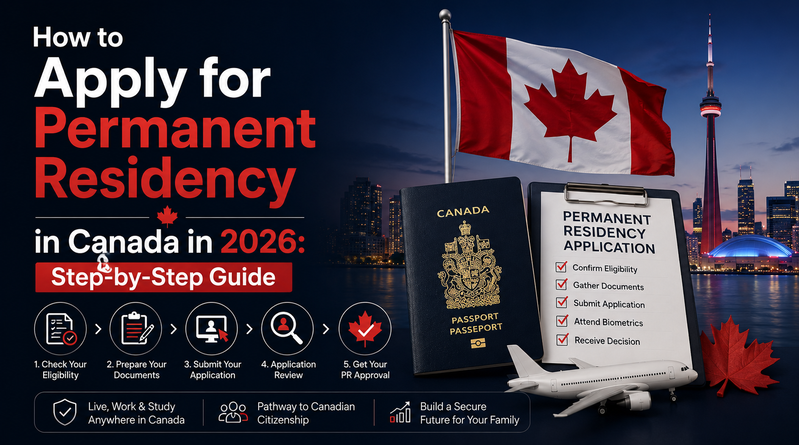

Canada permanent residency can open the door to long-term settlement, employment, education, and other opportunities in Canada. However, the application process depends on your immigration pathway, eligibility, qualifications, documents, and, in some cases, your ranking in the Express Entry pool.
If you are wondering how to apply for permanent residency in Canada, this guide explains the process step by step. It covers major pathways such as Express Entry, Provincial Nominee Programs (PNPs), and family sponsorship, along with eligibility requirements, CRS scores, documents, Invitation to Apply (ITA), fees, processing times, and what happens after you submit your application.
Important: Canadian immigration rules, fees, processing times, and Express Entry categories can change. Always verify current requirements with the Government of Canada before submitting an application.
Quick Answer: How to Apply for Permanent Residency in Canada
The Canada PR application process generally involves these steps:
Choose the immigration pathway that fits your circumstances.
Check the eligibility requirements.
Take an approved language test if required.
Obtain an Educational Credential Assessment (ECA), where applicable.
Calculate your Comprehensive Ranking System (CRS) score for Express Entry.
Gather your supporting documents.
Create an Express Entry profile if you qualify for an Express Entry program.
Enter the Express Entry pool and wait for an Invitation to Apply.
Submit your complete permanent residence application within the applicable deadline after receiving an ITA.
Complete biometrics, medical examinations, background checks, and other requested steps.
Wait for a decision and, if approved, receive your Confirmation of Permanent Residence (COPR).
Canada Permanent Residency Eligibility Requirements
Before you apply for permanent residency in Canada, you need to determine whether you qualify for an available immigration program.
Eligibility requirements vary depending on the pathway, but applicants may need to meet requirements related to:
Age
Education
Skilled work experience
English or French language ability
Canadian work experience
Provincial nomination
Proof of funds
Job offer, where applicable
Medical examination
Police certificates and background checks
For Express Entry, candidates must first qualify under one of the federal economic immigration programs managed through the system.
Your eligibility should be assessed against the specific program requirements rather than based only on your CRS score.
1. Choose the Right Canada PR Pathway
Canada offers several immigration pathways for people seeking permanent residence. The right option depends on your qualifications, work experience, family circumstances, language ability, and other factors.
Express Entry
Express Entry is an online system used to manage applications for three federal economic immigration programs:
Federal Skilled Worker Program
Federal Skilled Trades Program
Canadian Experience Class
Eligible candidates create an Express Entry profile and enter a pool of candidates. Their profiles receive a CRS score, and candidates may be invited to apply for permanent residence through an Express Entry draw.
Provincial Nominee Program
The Provincial Nominee Program allows participating provinces and territories to nominate candidates who meet the requirements of their immigration streams.
PNP streams can target different groups, including skilled workers, graduates, entrepreneurs, and candidates with particular occupational or regional profiles.
A provincial nomination can provide a significant advantage to an eligible Express Entry candidate.
Family Sponsorship
Canadian citizens and permanent residents may be able to sponsor eligible family members for permanent residence.
Depending on the Canadian immigration consultation program, eligible family members can include a spouse or common-law partner, dependent children, and certain other relatives.
Because sponsorship requirements vary by relationship, applicants should review the specific program requirements before applying.
2. Check Your Express Entry Eligibility
If Express Entry is your intended pathway, determine whether you meet the eligibility requirements of at least one of the programs managed through Express Entry.
For example, the Federal Skilled Worker Program considers factors such as:
Skilled work experience
Language proficiency
Education
Age
Adaptability
Arranged employment, where applicable
Applicants under the Federal Skilled Worker Program must meet the applicable selection requirements before entering the Express Entry pool.
Meeting the minimum eligibility requirements does not automatically guarantee an Invitation to Apply. Express Entry candidates are ranked using the CRS, and invitations depend on the type and results of draws conducted by Immigration, Refugees and Citizenship Canada (IRCC).
3. Calculate Your CRS Score
The Comprehensive Ranking System (CRS) is used to rank eligible Express Entry candidates.
Your CRS score can be influenced by factors including:
Age
Education
Language proficiency
Canadian work experience
Spouse or common-law partner factors
Skill transferability
Certain additional factors
Language test results can be particularly important because English and French proficiency can affect your ranking.
Applicants may use approved tests such as IELTS General Training or CELPIP General for English, and TEF Canada or TCF Canada for French, depending on the program and circumstances.
If you completed your education outside Canada, an Educational Credential Assessment (ECA) may also be required for the relevant immigration program.
Before creating your profile, use the official Government of Canada CRS resources to estimate your score and understand which factors may improve your ranking.
4. Understand Express Entry Category-Based Draws in 2026
Express Entry does not always operate through general draws based only on overall CRS rankings.
IRCC can also conduct category-based selection draws to invite candidates who meet specific economic or demographic priorities.
Categories can include areas such as:
Healthcare
Trades
Transport
STEM-related occupations
French-language proficiency
Other categories established by IRCC
The categories and eligibility requirements can change, so applicants should not rely on an old list of categories when planning their immigration strategy.
If you meet the requirements for an active category, you may have an additional opportunity to receive an ITA through a category-based draw.
Always check the latest Express Entry category requirements and rounds of invitations published by IRCC before making an application decision.
5. Prepare Your Canada PR Documents
Preparing your documents early can help reduce delays when you are ready to submit your application.
Depending on your immigration program and personal circumstances, documents may include:
Valid passport
Language test results
Educational Credential Assessment
Educational certificates and transcripts
Employment reference letters
Proof of work experience
Proof of funds, where required
Police certificates
Medical examination documents
Provincial nomination documents, where applicable
Job offer documentation, where applicable
Family or civil-status documents
Translations of documents where required
Language Test Results
Language test results must meet the validity requirements applicable to your immigration application.
Your language scores can also have a significant effect on your Express Entry profile and CRS ranking.
Educational Credential Assessment
If you completed education outside Canada, an ECA from an approved organization may be required for your immigration program.
Because obtaining an ECA can take time, it is sensible to start this process early if your program requires one.
Proof of Funds
Some applicants must demonstrate that they have sufficient funds to support themselves and eligible family members after arriving in Canada.
The amount required can depend on family size and is subject to change. Applicants should check the latest IRCC requirements rather than relying on an outdated amount.
6. Create Your Express Entry Profile
Once you have confirmed your eligibility and gathered the required information, you can create an Express Entry profile through the appropriate Government of Canada system.
You may need to provide information about:
Personal details
Education
Language test results
Work experience
Canadian work experience
Family information
Job offer, if applicable
Provincial nomination, if applicable
After submitting your profile, you enter the Express Entry pool if you meet the relevant requirements.
Your profile receives a CRS score and remains in the pool for the applicable period. If you do not receive an ITA before your profile expires, you may be able to create a new profile if you still meet the requirements.
7. Receive an Invitation to Apply
An Invitation to Apply (ITA) means that IRCC has invited you to submit an application for permanent residence.
Receiving an ITA does not mean that you automatically become a permanent resident.
After receiving an ITA, carefully review the instructions and prepare the complete application within the specified deadline.
You will generally need to provide supporting evidence for the information declared in your Express Entry profile.
This can include work experience documentation, police certificates, medical examination results, proof of funds where required, and other supporting documents.
8. Submit Your Canada PR Application
After receiving an ITA, complete your permanent residence application through the appropriate online process.
Before submitting, carefully check that:
All required forms are complete.
Your information is accurate and consistent.
Supporting documents are included.
Documents are valid and readable.
Applicable fees have been paid.
Translations meet the required standards.
Required family information has been provided.
An incomplete or inaccurate application can result in delays or other problems. Review the applicable document checklist carefully before submission.
9. Complete Biometrics, Medical and Background Checks
After submitting your application, you may be required to complete additional steps.
These can include:
a) Biometrics
Applicants who are required to provide biometrics will receive instructions explaining how and when to complete this requirement.
b) Medical Examination
Applicants may need to complete an immigration medical examination with an approved panel physician.
c) Police Certificates
Police certificates may be required depending on your age, residence history, immigration program, and other circumstances.
d) Background Checks
IRCC may conduct background and security checks as part of the application process.
Respond promptly if IRCC requests additional information or documentation.
10. How Much Does It Cost to Apply for Canada PR?
The cost of applying for permanent residence depends on the immigration program and the people included in the application.
Potential expenses can include:
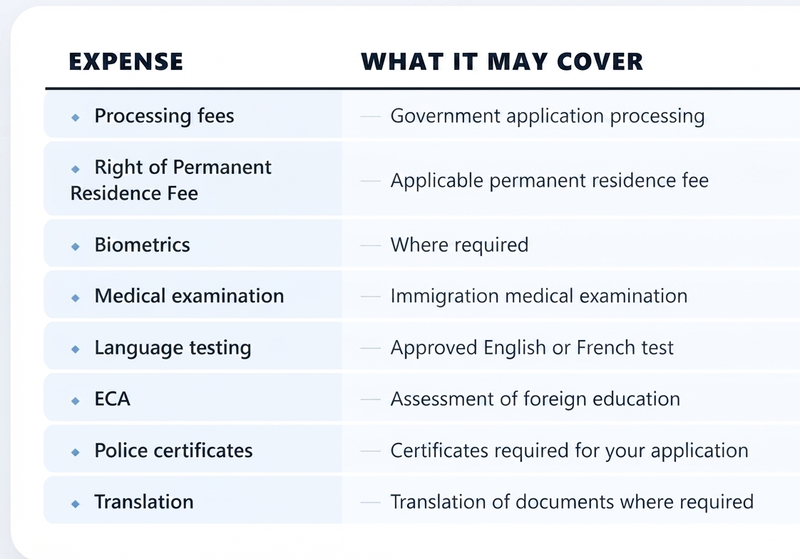
Government fees can change, so applicants should confirm the latest amounts on the official Government of Canada website before submitting an application.
11. How Long Does Canada PR Take?
There is no single timeline that applies to every Canada PR applicant.
Your overall timeline can include:
Preparation time → Express Entry profile → Waiting for ITA → PR application submission → Biometrics/medical/background checks → Final decision
For Express Entry applicants, the time spent waiting for an ITA can vary significantly depending on factors such as CRS score, draw type, category eligibility, and IRCC invitation patterns.
After an application is submitted, processing time can also vary depending on the program and individual circumstances.
Instead of relying on an old fixed processing time, check IRCC’s current processing-time information before making travel, employment, or relocation decisions.
12. What Happens After Your Canada PR Application Is Approved?
If your application is approved, you may receive confirmation of your permanent resident status and your Confirmation of Permanent Residence (COPR).
The final steps can include:
Receiving instructions from IRCC.
Completing the confirmation process.
Receiving your COPR.
Completing the applicable landing or confirmation process.
Receiving your permanent resident card according to the applicable process.
Keep your immigration documents safe and follow all instructions provided by IRCC.
Canada PR Application Checklist
Use this checklist as a starting point when preparing your application:
Choose your immigration pathway.
Check your eligibility.
Take an approved language test.
Obtain an ECA if required.
Calculate your CRS score.
Gather education and employment documents.
Prepare proof of funds if required.
Create your Express Entry profile if eligible.
Monitor Express Entry draws.
Review your ITA carefully if invited.
Prepare your complete PR application.
Pay the applicable government fees.
Complete biometrics if required.
Complete your medical examination.
Provide police certificates where required.
Respond to IRCC requests.
Monitor your application status.
Final Thoughts
Knowing how to apply for permanent residency in Canada is only the first step. A successful application requires careful program selection, accurate information, complete documentation, and attention to the latest IRCC requirements.
Express Entry, Provincial Nominee Programs, and family sponsorship can offer different routes to Canadian permanent residence, but eligibility and application requirements vary.
Before submitting your application, verify current program criteria, fees, processing times, and Express Entry categories through official Government of Canada resources. If your circumstances are complex or you are unsure which pathway is appropriate, consider obtaining advice from a qualified Canadian immigration professional.
Disclaimer: This article is provided for general informational purposes and does not constitute legal or immigration advice. Canadian immigration programs, fees, processing times, and eligibility requirements can change. Confirm the latest information with the Government of Canada or consult an appropriately licensed Canadian immigration professional before making an application decision.

Comments
No comments yet. Be the first to comment!